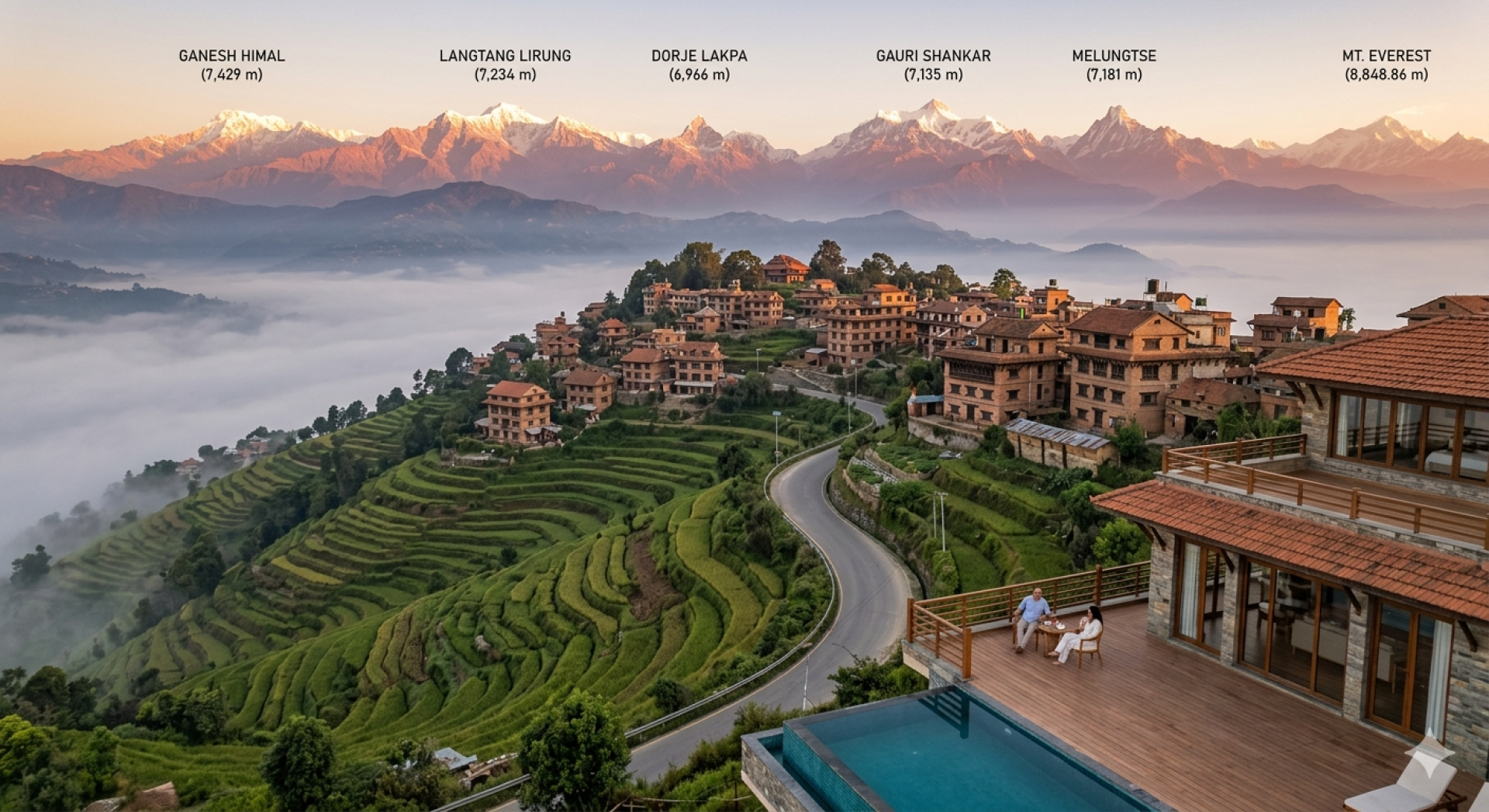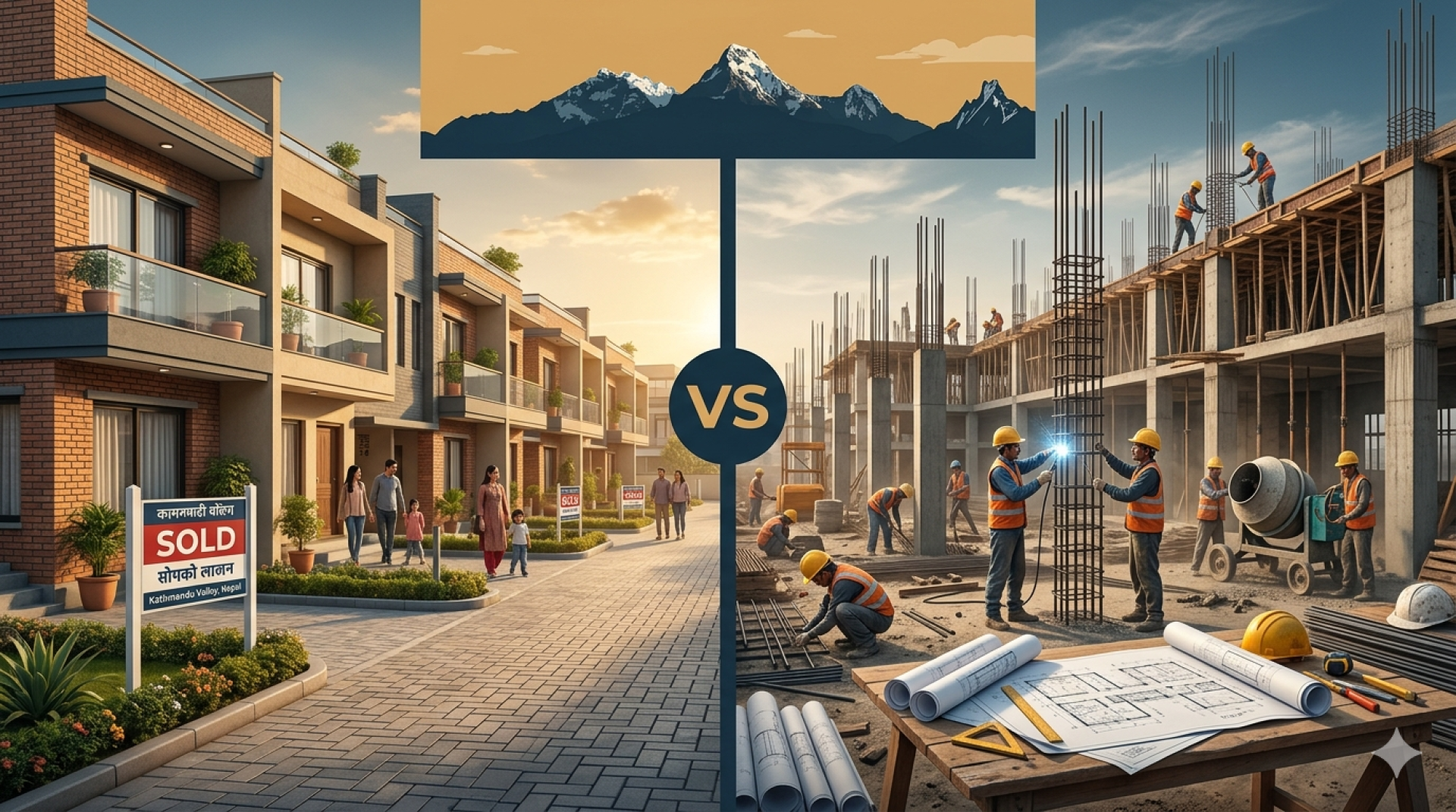
The Big Picture: Why This Decision Is Complex in Nepal
Unlike many countries where the real estate market is transparent and mature, Nepal's property landscape is shaped by rapidly rising land prices, evolving municipal regulations, inconsistent construction quality, and a culture of self-built homes. The decision isn't just financial — it's deeply personal, logistical, and generational.
Whether you're a first-time buyer in Kathmandu, a family returning from abroad, or someone planning to settle in Pokhara or Chitwan, the calculus looks very different depending on your timeline, budget, land access, and risk tolerance.
This guide focuses primarily on the Kathmandu Valley but most principles apply across Nepal's urban and semi-urban areas. Property values referenced are approximate 2024–2025 market rates.
Cost Breakdown: What Does Each Actually Cost?
The cost difference between buying and building can be significant — or surprisingly narrow — depending on location, specifications, and whether you already own land. Here's a realistic comparison for a mid-size urban home in the Kathmandu Valley:
| Cost Element | Buy Ready-Made | Build Your Own |
|---|---|---|
| Land (5 anna, Ring Road area) | Included in price | NPR 80L – 1.5Cr |
| Construction / Unit Cost | Already built | NPR 3,500–5,000/sq.ft |
| Total Package (1,500 sq.ft house) | NPR 1.8Cr – 3.5Cr | NPR 1.4Cr – 2.8Cr* |
| Registration & Transfer Tax | 4–6% of property value | Land registration only |
| Agent / Commission Fees | 1–2% (negotiable) | None (if direct contractor) |
| Architect / Engineering Fees | Included | NPR 2–5L additional |
| Contingency (overruns) | Minimal (fixed price) | 10–20% extra is common |
| Time to Move In | 1–3 months | 18–36 months |
* Building cost assumes you already own land or are purchasing separately. Significant savings possible in areas outside Kathmandu.
Self-built homes in Nepal frequently exceed budget by 20–35% due to material price volatility, unexpected ground conditions, contractor disputes, and municipality revision requirements. Always keep a substantial contingency fund.
Buying a Ready-Made House: Pros, Cons & Pitfalls
The ready-made market in Nepal has matured significantly over the past decade. From townships in Budhanilkantha to row houses in Bhaktapur and Lalitpur, there are more options than ever — but buyer beware: quality varies enormously.
- Move in within weeks to months
- Fixed, known total cost upfront
- No construction stress or supervision
- Easier to get bank financing (collateral ready)
- Established neighborhood & infrastructure
- Interior design choices already made
- Better resale liquidity in premium segments
- Premium price — you pay for developer's profit margin
- No customization of layout or materials
- Hidden defects may only appear later
- Construction quality often hard to verify
- Land size is non-negotiable
- Township rules may restrict modifications
- Older resale homes may need expensive renovation
What to Inspect Before Buying
-
Lalpurja (land ownership certificate): Verify the seller is the legal owner. Check for any encumbrances or disputes at the Land Revenue Office.
-
Napi (Survey) Records: Match the physical plot boundaries with cadastral maps. Discrepancies are common in older properties.
-
Building Permit (Naksha Pass): Confirm the building was constructed with municipal approval. Unpermitted floors are a major liability.
-
Structural Inspection: Hire an independent civil engineer — not the seller's — to inspect columns, beams, and foundation. Cost: NPR 15,000–40,000. Worth every paisa.
-
Water & Road Access: Confirm permanent road access and water source. Many properties outside ring roads have seasonal or shared water issues.
Building From Scratch: Freedom, Risk & Reward
The vast majority of Nepali families who own land choose to build their own homes. It's culturally ingrained, often more cost-effective when you already have land, and allows complete customization. But it demands time, attention, and patience most people underestimate.
- Full control over design, materials & layout
- Can build in phases as budget allows
- Potentially lower cost than buying
- Modern earthquake-resistant design by choice
- No developer's markup — all equity is yours
- Personalized to family's exact needs
- Requires significant time and hands-on management
- High risk of contractor fraud or poor workmanship
- Costs routinely exceed initial estimates
- Municipality approval process can be slow
- Years before you can move in
- Material prices volatile (cement, rebar, etc.)
The Construction Process in Nepal
-
Hire a Licensed Architect: A Nepal Engineering Council (NEC) registered architect must prepare drawings. Budget NPR 1–5 lakh depending on home size and complexity.
-
Get Municipality Approval (Naksha Pass): Submit drawings to your local municipality or metropolitan office. Can take 1–6 months depending on the municipality's backlog and whether your design meets setback rules.
-
Select a Contractor: Get at least 3 quotes. Prefer contractors with verifiable completed projects and references. A written contract specifying materials, timeline, and payment milestones is non-negotiable.
-
Construction Phase: RCC frame construction typically takes 12–24 months for a 2–3 storey home. Budget for regular site visits or hire a site supervisor if you can't be present daily.
-
Completion Certificate: After construction, get a Building Completion Certificate from the municipality before occupying. Required for bank loans and future resale.
Nepal's construction industry has widespread use of informal labor. Always insist on a written contract with milestone-based payments (never full payment upfront), and hold 10% retention until 6 months after completion to cover defects.
The Land Question: Everything Starts Here
In Nepal, land value often dwarfs construction cost — especially in Kathmandu Valley. The decision to buy vs. build frequently comes down to one simple factor: do you already own land?
- Building is almost always cheaper
- Highest customization freedom
- No competition from other buyers
- Can stage construction over years
- Full design control including vastu
- Land + build cost may exceed ready-made price
- Risk of overpaying in speculative market
- 2-step financing is more complex
- Finding good land in urban areas is hard
- Check zoning before purchase
Always verify land zoning (residential vs. agricultural) with the municipality before purchase. Buying agricultural land for housing construction is not permitted without land conversion (Raikar to Abadi), which adds cost and time. Flood zone and landslide risk maps are available at Department of Mines and Geology.
Legal & Documentation: What You Can't Skip
Nepal's property registration system, while improving, still requires careful attention to documentation. Many disputes arise from incomplete due diligence. Here are the critical documents for both paths:
- Lalpurja (ownership certificate)
- Naksha Pass (building permit)
- Char Killa (boundary certificate)
- Tax clearance certificate
- Registration deed (Rajinama)
- No Objection Certificate (if applicable)
- Completion certificate
- Lalpurja for the land
- Architectural drawings (NEC stamped)
- Municipality approval (Naksha Pass)
- Contractor agreement
- Material bills and receipts
- Completion inspection reports
- Completion certificate (Sampurna)
Home Loans in Nepal: What Banks Actually Offer
Nepali banks and financial institutions offer home loans for both buying and building, but the terms differ meaningfully between the two scenarios.
| Feature | Loan for Buying | Loan for Building |
|---|---|---|
| Loan-to-Value (LTV) | Up to 60% of property value | Up to 50% of estimated cost |
| Collateral | The property being purchased | Land + partial construction |
| Disbursement | Lump sum on registration | In stages (tranche-based) |
| Interest Rate (2025) | 10–13% per annum | 11–14% per annum |
| Tenure | Up to 20–25 years | Up to 15–20 years |
| Processing Ease | Easier (clear collateral) | More complex (multiple disbursements) |
Nepal Rastra Bank (NRB) periodically revises loan-to-value caps for real estate. Always check the current NRB circular before applying. Some development banks and cooperatives offer more flexible terms for construction loans but at higher rates.
Earthquake Safety: Nepal's Non-Negotiable
The 2015 Gorkha earthquake devastated over 600,000 structures. For any Nepali family making a housing decision, seismic safety cannot be treated as an afterthought — it's the foundation of every other consideration.
- Was it built post-2015 NBC codes?
- Ask for structural drawings
- Hire structural engineer for inspection
- Check column/beam dimensions
- Avoid soft ground or riverbed locations
- Look for visible cracks in columns
- Design to NBC 105:2020 standards
- Use NEC-registered structural engineer
- Specify rebar diameter and spacing in contract
- Conduct soil bearing test before foundation
- Use M20 or higher grade concrete
- Document construction at each stage
Many older Kathmandu houses — and some recently built ones — do not meet Nepal National Building Code (NBC) seismic standards. A structurally unsafe house at any price is no bargain. The DUDBC (Department of Urban Development and Building Construction) has free resources on earthquake-resistant construction.
Decision Checklist: Which Path Is Right for You?
There is no universal answer — only the right answer for your specific situation. Use this checklist to guide your thinking:
- You need to move in within 6 months
- You don't have time to supervise construction
- You don't own land in your target area
- You want a fixed, predictable total cost
- You're buying in a well-managed township
- Your budget is above NPR 2 crore
- You plan to resell within 5–7 years
- You already own land
- You have 2–4 years before you need to move
- Customization of layout is important
- You want to build in phases
- You have a trusted contractor network
- You're in a location with limited ready homes
- You want to maximize long-term equity
The Honest Verdict
For most Nepali families, building on owned land offers the best value — if you have the time, patience, and project management capability. For families needing to move quickly, without land, or unwilling to manage contractors, a quality ready-made home in a reputable township is the wiser, lower-stress choice.
Whichever path you choose, invest in professional due diligence. The cost of a good lawyer, structural engineer, and licensed architect is trivial compared to the cost of discovering problems after the fact.